

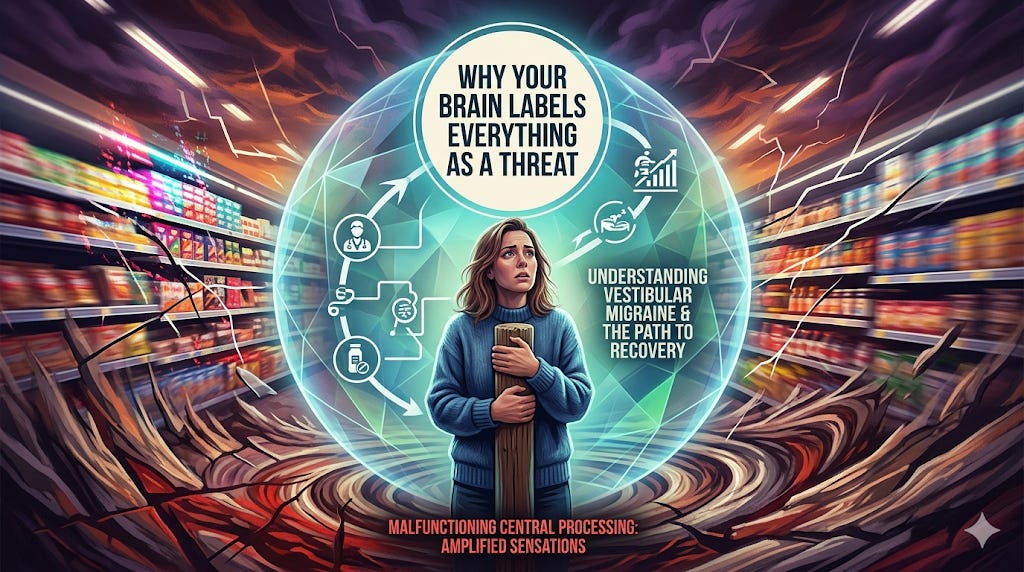
In this episode, we dive deep into the exhausting reality of living with complex balance disorders like vestibular migraine, PPPD, and MdDS. If you have ever felt like your brain is suddenly labeling everyday environments, lights, and open spaces as an absolute threat, there is a precise neurological reason for it.
Here is what is actually happening inside your nervous system and how you can begin to find your footing again:
The Signals Are Normal, but the Processing Malfunctions
Your inner ears are typically healthy and sending perfectly normal movement signals. The real breakdown happens in the central pathways of your brain. During a migraine, the brain centrally misinterprets and amplifies normal sensory input, turning it into a nonstop internal sensation of rocking, swaying, or dropping.
The Emergency Survival Choices Your Brain Makes
To cope with this internal chaos and sensory mismatch, your central nervous system adopts emergency survival strategies to keep you upright:
A Strong Visual Component: Because the central balance data is so chaotic, your brain forces a state of severe visual dependency. Your eyes have to work overtime to figure out which way is up, so busy spaces like grocery stores or a sunny porch can completely overload your brain.
A Strong Somatosensory Component: To keep you from falling, your brain anchors itself tightly to the firmest physical surfaces available, like the floor or a chair. The moment you step into an open space where those close boundaries disappear, a wave of panic hits because your brain feels completely ungrounded.
How to Turn Down the Internal Alarm
Your brain is not permanently broken; it is locked in a hyper-reactive survival loop. You can systematically retrain your central nervous system to feel safe on Earth again by taking clear, progressive steps:
Use strategic medical guidance to serve as a temporary volume dampener and quiet the hyper-reactive central pathways.
Implement short, timed intervals of environmental exposure to build tolerance without triggering a panic response.
Partner with dedicated vestibular specialists who can guide you through precise desensitization protocols.
Tune in to understand the science behind this sensory mismatch and learn how to help your nervous system step down from a constant fight-or-flight state.


