


Podcast Episode Review for Patients
In this episode of the podcast, we unpack a common point of confusion for individuals living with chronic, non-spinning dizziness: distinguishing between Persistent Postural-Perceptual Dizziness (PPPD) and Mal de Débarquement Syndrome (MdDS). While both conditions produce a continuous sensation of spatial disorientation, unsteadiness, or floating, they stem from completely opposite failures of how the brain adapts to its surroundings.
Please note that when we describe MdDS, this encompasses both classical, motion-triggered presentations and spontaneous or atypical MdDS, which develops without a prolonged passive motion event. In all instances, whether an initial trigger is present or absent, the underlying central mechanism remains a critical focus.
We break down the core features of each condition to help you better understand what is happening inside your nervous system:
The Onset and Triggers:
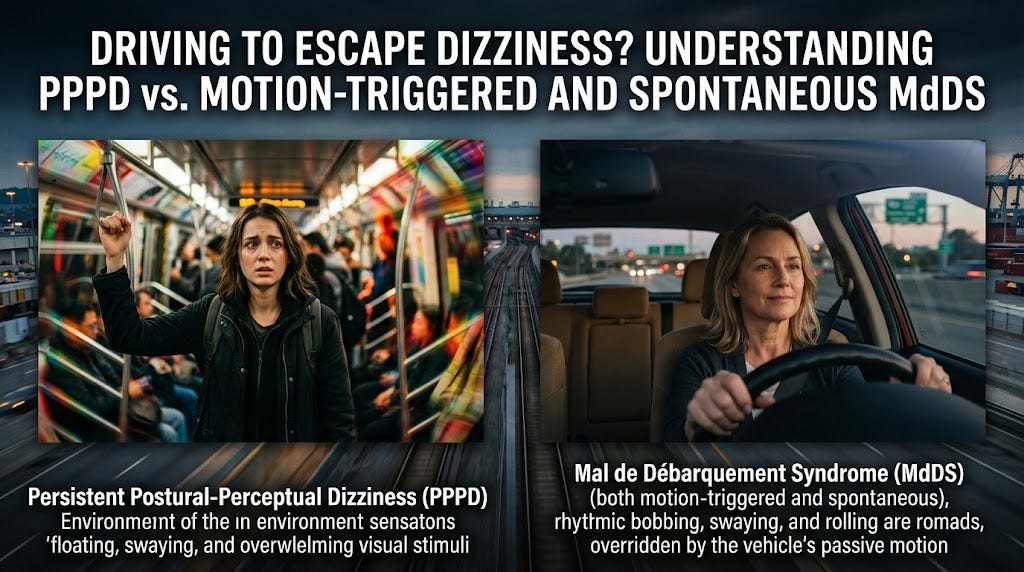
PPPD typically develops after an acute vestibular crisis, medical event, or panic episode where the brain stays stuck in a high-vigilance state, executing a maladaptive sensory strategy. Classical MdDS is triggered by prolonged exposure to passive transport—such as a cruise, flight, or long drive—where the nervous system adjusts to the passive oscillation and fails to clear the adaptation phase once back on solid ground. Crucially, spontaneous or atypical MdDS presents with the exact same internal sensations and movement-based patterns but occurs without any preceding travel or motion.
The Motion Paradox:
We explore the single most important diagnostic clue: how you respond to passive movement. For individuals with PPPD, riding in a car or moving around typically intensifies symptoms by overwhelming a hypervigilant brain. For individuals with both triggering and non-triggering MdDS, riding in or driving a vehicle temporarily resolves or significantly decreases the internal bobbing, swaying, or rolling because the external motion overrides the internal phantom rhythm.
Environmental Sensitivity:
We discuss how these conditions interact with the physical world. Patients presenting with PPPD exhibit a strong visual and somatosensory component, over-weighting external environmental cues, which makes visually rich spaces like grocery store aisles incredibly overwhelming. Conversely, those with MdDS—regardless of onset type—are driven by an internal central oscillator, meaning their symptoms are primarily exacerbated by a completely static environment with no physical motion to override the sensation.
Tune in to learn how understanding these specific sensory mismatches helps vestibular professionals accurately identify your condition and design the correct rehabilitation strategy tailored to your recovery.


