

If you are living with Persistent Postural-Perceptual Dizziness (PPPD), you already know how exhausting it is. Everyday environments—like grocery store aisles, scrolling on a phone, busy patterns on a floor, or simply standing upright—can feel overwhelmingly unstable.
If you have tried traditional vestibular rehabilitation and felt like it made you worse, you are not alone.
Standard physical therapy often relies on “habituation”—asking you to just push through the dizziness, get used to movement, and tolerate the symptoms.
But for a brain stuck in PPPD, pushing harder only rings alarm bells in your nervous system, flooding an already exhausted amygdala with panic and making your symptoms worse.
Your dizziness is not a sign that your inner ear is broken. It is a sign that your central nervous system is caught in a hyper-vigilant survival loop.
Understanding the Loop: Why Your Brain Feels Unsafe
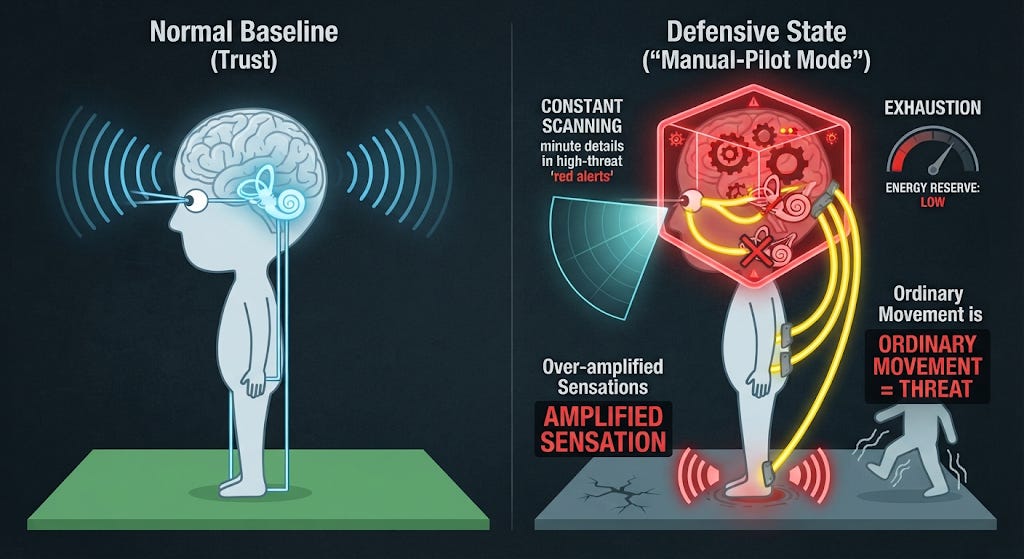
Following an initial trigger—such as a vestibular event, a panic attack, or a major stressor—your brain failed to return to its normal baseline. Instead, it locked into a defensive software state.
To protect you, your brain did two things:
It stopped trusting your vestibular system.
It began with over-relying on your visual and somatosensory (body-surface) systems to act as rigid, noisy safety braces.
Your brain is working overtime in “manual-pilot mode,” constantly scanning the environment for threats and over-amplifying normal sensations. It treats ordinary movement like a life-threatening event because it needs constant proof that the ground is safe.
The Patient Experience: How The Zero Øut Method™ Works
The Zero Øut Method™—built on close to 30 years of clinical experience and grounded in neurological science—does not ask you to suffer through symptoms. Instead, it acts as a structured, step-by-step physical and neurological reset.
Instead of forcing you into uncomfortable upright movements right away, our treatment protocol takes a completely different path:
Step 1: Finding Your True “Zero” (The Somatosensory Anchor)
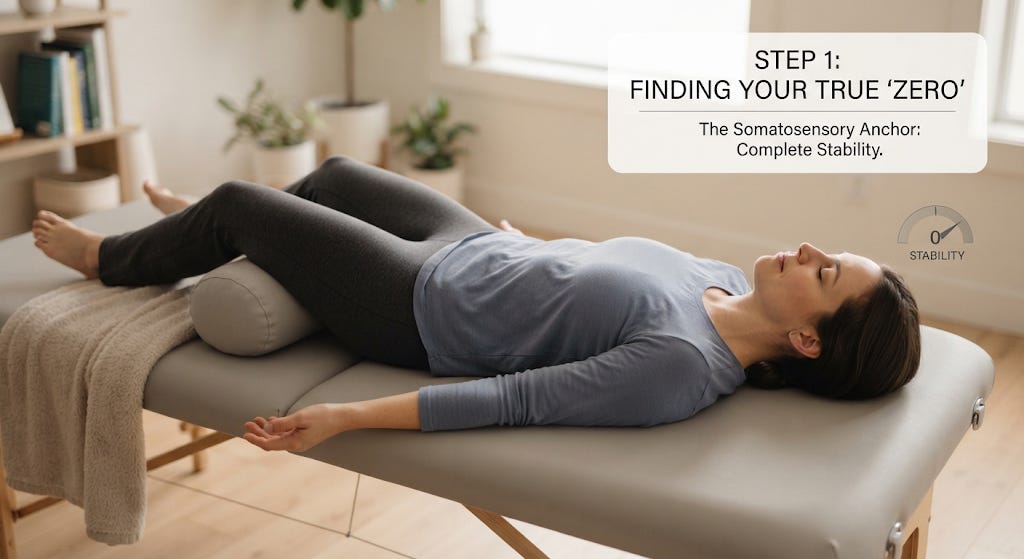
What it looks like: We begin by finding the exact resting posture (often fully supported supine or semi-reclined) where your dizziness, visual distortion, and anxiety drop to an absolute 0 out of 10.
Why it works: Lying flat maximizes surface contact with your body, flooding your mechanoreceptors with safety signals and quietening the overactive error-detection loops in your brain. It proves to your nervous system—and to your amygdala—that complete stability is possible.
Step 2: Autonomic Down-Regulation
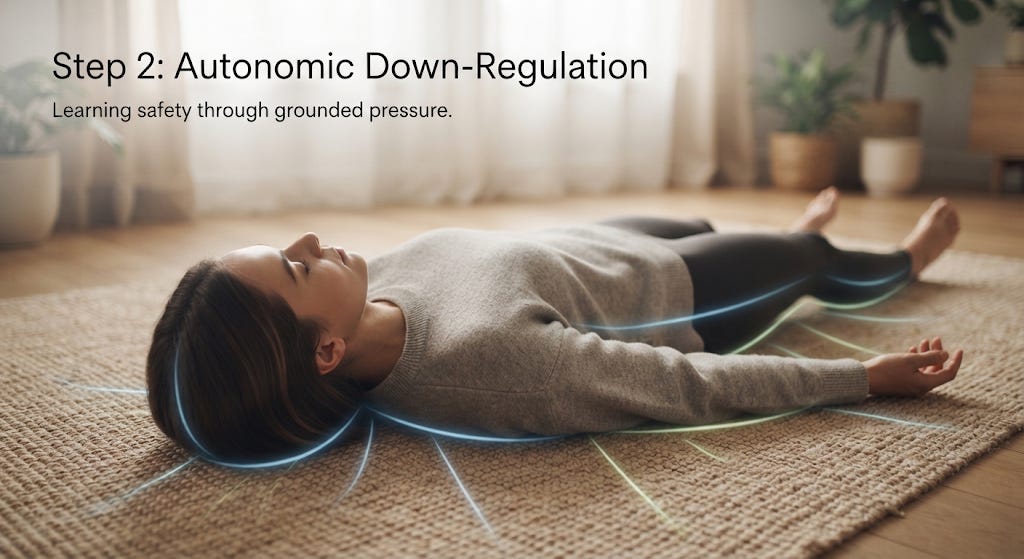
What it looks like: While safely resting at your baseline, you learn to direct your attention to the unyielding surface pressure beneath you, decoupling physical space from panic.
Why it works: This lowers your systemic gain, allowing your nervous system to recognize that low-level vestibular signals are safe and letting your hypervigilance finally quiet down.
Step 3: Controlled Optokinetics and Behavioral Adaptation
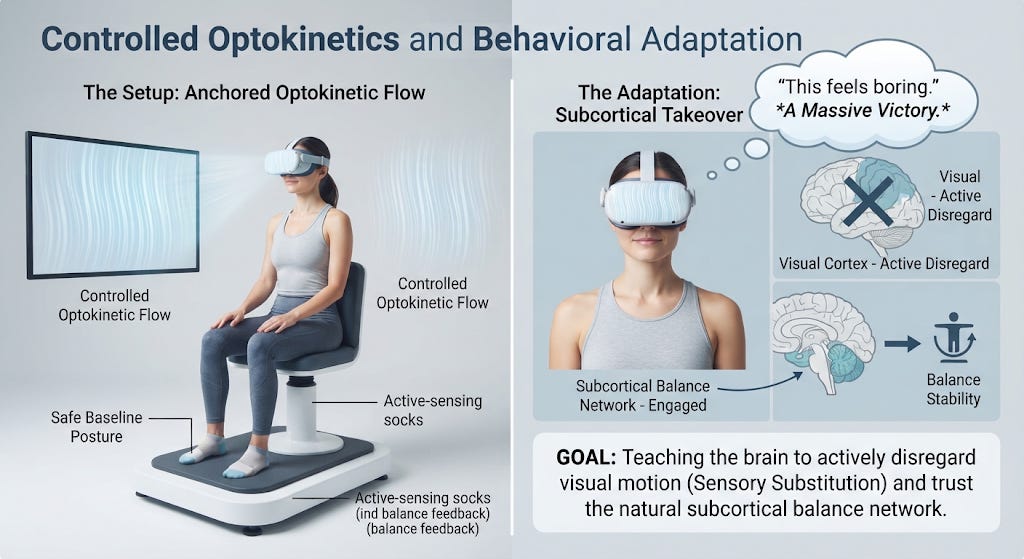
What it looks like: While securely anchored in your safe baseline posture, we introduce controlled optokinetic flow.
The Goal: We aren’t trying to make you “get used to” the visual motion through passive desensitization or habituation. Instead, we are teaching your brain to actively disregard it. Through controlled, structured positioning, you execute behavioral and sensory substitution so your brain realizes it no longer needs vision to anchor your balance.
The Patient Perspective: When you first practice these optokinetic exercises, you might find them remarkably dull or uneventful. If you think, “This feels boring,” that is a massive victory. That boredom is concrete proof that your brain has successfully stopped treating the visual flow as a crisis—it is simply shutting down the unneeded visual reliance and allowing your natural subcortical balance network to take over.
Step 4: Moving Away From Zero (Controlled Developmental Ascent)
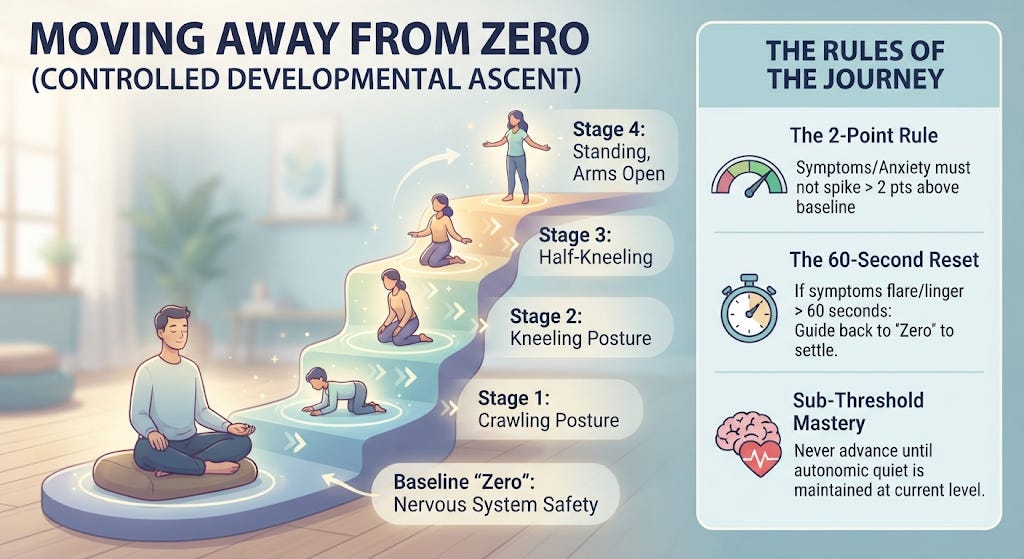
What it looks like: Once your nervous system consistently feels safe at zero, we guide you through a carefully paced sequence of movements modeled after natural developmental milestones (moving up through developmental postures).
The Rules of the Journey: To ensure your brain never triggers a threat response, we follow strict boundaries:
The 2-Point Rule: Your symptoms or anxiety must never spike more than 2 points above baseline during movement.
The 60-Second Reset: If symptoms flare or linger for more than 60 seconds, we immediately guide you back to your baseline “Zero” position to settle the system.
Sub-Threshold Mastery: We never advance to a higher posture until your nervous system maintains complete autonomic quiet at your current level.
The Clinical Bottom Line
Recalibrating PPPD is not about enduring dizziness until you desensitize. It is about dismantling a neurological survival response piece by piece.
By establishing a true baseline of safety and using a gentle, step-by-step developmental ascent, we help your brain let go of its exhausting manual controls. Slowly, safely, and predictably, we guide your nervous system back out of hyper-vigilance and restore your natural, fluid subcortical balance.
You don’t have to live trapped in a high-gain loop. Stability is achievable, and we can build the path back to normal, functional movement together.
Professional Notice and Clinical Framework
Statement of Clinical Interpretation & Independent Inquiry
The diagnostic models, therapeutic sequencing, and degaussing methodologies discussed in this publication—specifically The Zero Øut Method™—represent the independent clinical synthesis, ongoing real-world investigation, and professional framework developed by Brian Keith Werner, PT, MPT. While this work builds upon and respects established peer-reviewed neuroanatomical data regarding the velocity storage integrator, otolithic function, and sensorimotor pathways, the multi-axial, anchor-based application detailed herein is an evolving clinical strategy designed to address cases where single-axis legacy protocols fall short.
The Reality of Clinical Innovation & Real-World Evidence
Science does not advance by standing still. When traditional, legacy single-plane protocols fail to resolve refractory or spontaneous cases of Mal de Débarquement Syndrome (MdDS) and Persistent Postural-Perceptual Dizziness (PPPD), clinicians have a professional and ethical obligation to closely examine the data, consider patient outcomes, and refine how we apply foundational physiological laws. This framework is driven by real-world clinical evidence, patient-centered tracking, and rigorous operational logic. It is presented as an open invitation for clinical peer review, critical discussion, and collaborative scientific inquiry—not as a finalized, dogmatic mandate.
Professional Scope and Legal Boundary
This material is published strictly for educational, informational, and professional discussion purposes among licensed healthcare providers and individuals exploring advanced neuro-vestibular recovery strategies. As a licensed physical therapist with decades of specialized clinical experience, the author provides these insights as a professional educational framework. This content does not constitute formal medical diagnosis, clinical treatment prescription, or a guarantee of specific outcomes. Practicing clinicians retain sole personal and professional responsibility for evaluating, screening, and applying independent judgment when managing individual patients.
Intellectual Property & Copyright Notice
Copyright © 2026 Brian Keith Werner, PT, MPT, and the Werner Institute. All Rights Reserved. The concepts of central nervous system degaussing, multi-axial state-space resets, and The Zero Øut Method™ are protected intellectual property. Authorized professional review and clinical discussion are permitted, provided explicit and prominent attribution is given to the author.