
Why Does Talking Make Me Dizzy? Understanding Social Sensory Overload

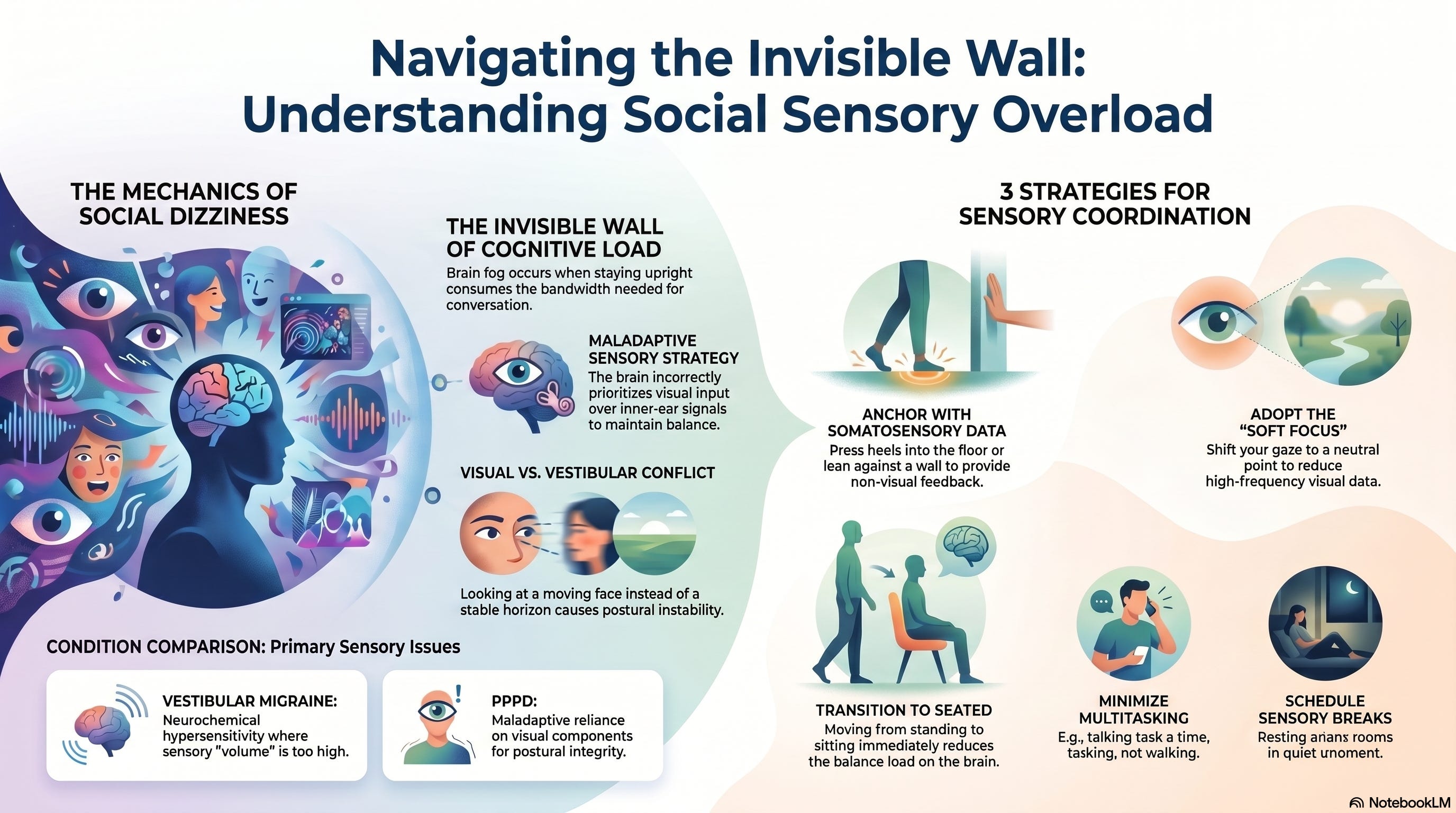
Sensory-cognitive overload is a clinical state where the brain becomes overwhelmed by the simultaneous demands of processing visual social cues, maintaining upright postural stability, and formulating complex speech. This phenomenon frequently occurs in patients with Vestibular Migraine and Persistent Postural-Perceptual Dizziness (PPPD) as a result of a “maladaptive sensory strategy” that prioritizes visual input over vestibular signals.
The Invisible Wall of Social Dizziness
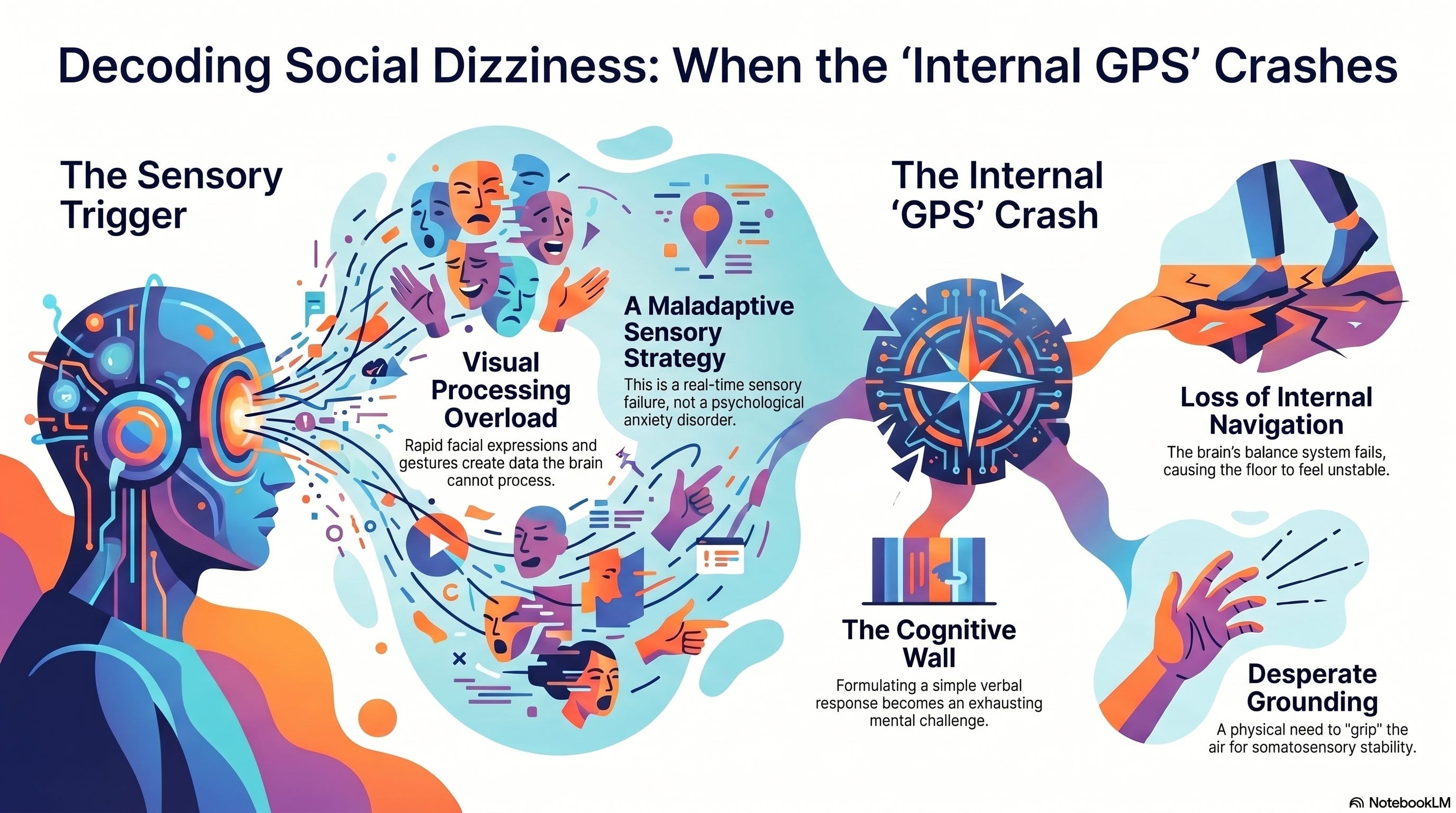
“Imagine you finally feel ‘up’ for a social gathering. You walk into a friend’s house, the air is filled with music, and you are genuinely excited to catch up.
But within five minutes of standing in a small circle, the floor starts to move. You are looking at your friend’s face as they talk, but their expressions and gestures create a ‘strong visual component’ that your brain simply cannot process.
Suddenly, the simple act of ‘thinking’ of a response feels like a massive ‘cognitive challenge’. You feel a wave of anxiety, not because of the people, but because your ‘internal GPS’ is crashing.
Even as a clinician who understands the mechanics of balance, you find yourself ‘gripping’ the air, desperate for a ‘strong somatosensory component’ to stop the world from spinning. You are not ‘anxious’ in the traditional sense; you are experiencing a ‘maladaptive sensory strategy’ in real-time.”
Is Social Dizziness a Symptom of Vestibular Migraine or PPPD?
While both conditions involve sensory mismatch, they process social overload differently. In Vestibular Migraine, the brain exhibits neurochemical hypersensitivity, in which the “volume” of sensory input is too high, making the movement of a speaker’s face physically taxing. In PPPD, the brain has shifted to a maladaptive strategy where it relies on a “strong visual component” for balance. When you look at a moving face instead of a stable horizon, your postural integrity vanishes. This creates a conflict between what you see and what your inner ear feels, leading to the sensation of being “overwhelmed.”
How Does a Maladaptive Sensory Strategy Cause Brain Fog?
When you engage in a close-proximity conversation, your brain must coordinate several high-demand tasks. It has to process the visual movements of the speaker’s mouth and eyes, filter out background noise, maintain an upright posture, and execute complex linguistic processing. When the brain lacks efficient sensory integration, it allocates too many resources to staying upright, leaving very little bandwidth for the conversation itself. This results in the “brain fog” and cognitive fatigue that many patients report.
What Are Five Strategies to Manage Vestibular Symptoms in Social Situations?
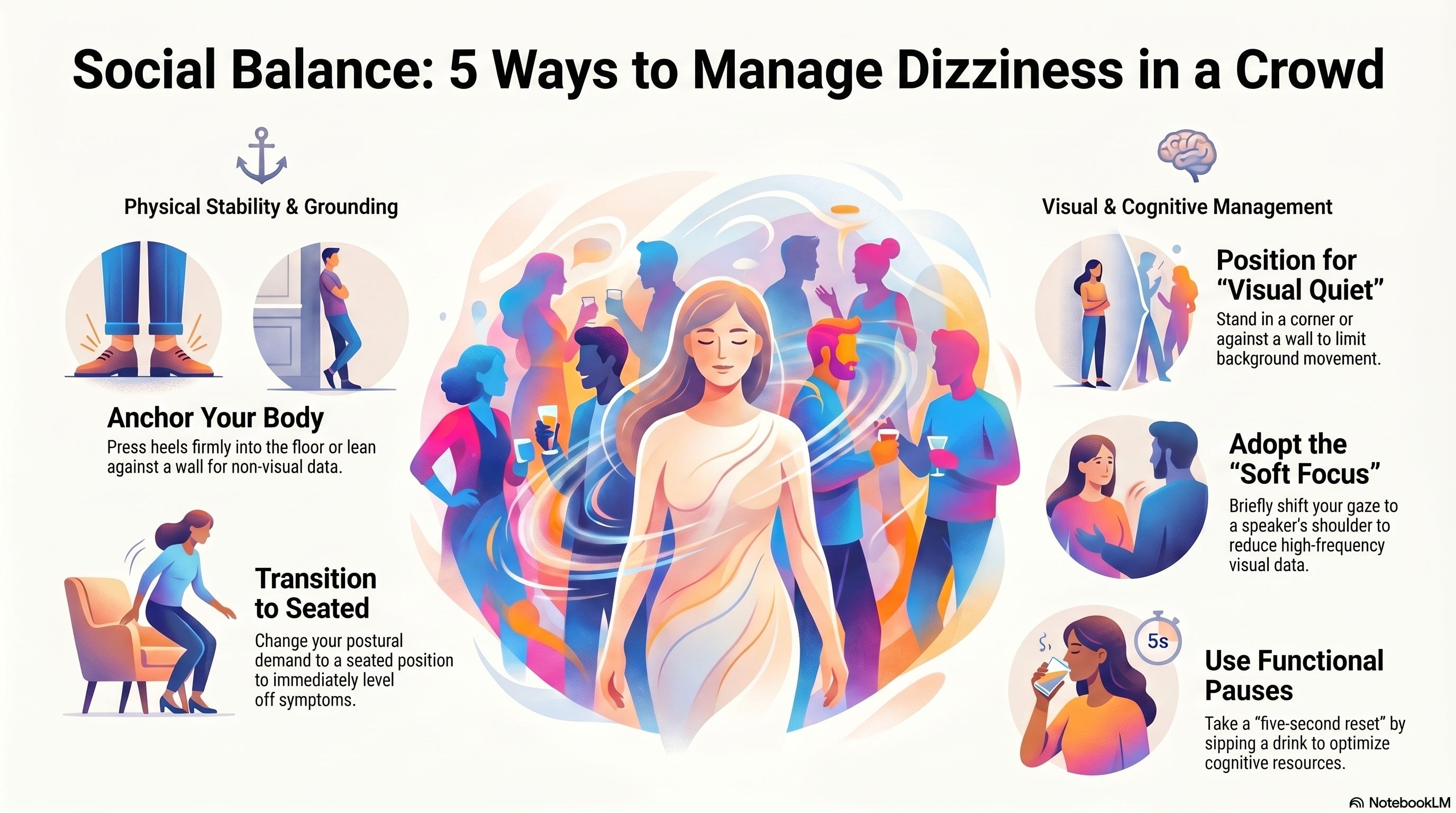
1. Anchor the body with a strong somatosensory component
The moment you feel your symptoms rise, you must use your environment to provide the brain with “non-visual” data. Press your heels firmly into the floor or lean your shoulder against a doorframe. Increasing the tactile feedback from a stable surface helps the brain ignore the conflicting visual signals from the crowd.
2. Adopt the Soft Focus or Pivot Gaze
Intense eye contact can overload the visual system during a symptom spike. Briefly shift your gaze to the speaker’s shoulder or a neutral point on the wall behind them. This “visual break” reduces the high-frequency data your brain must signal, allowing your vestibular system a moment to “re-center” without you appearing disengaged.
3. Position yourself for Visual Quiet
At a party, the background movement of other people creates “visual noise.” Position yourself in a corner or with your back to a solid wall. By limiting the visual field behind the person you are talking to, you support your brain’s ability to focus on the immediate interaction.
4. Use Cognitive Pacing with a functional pause
The cognitive challenge of formulated speech can spike dizziness. If you feel overwhelmed, take a slow sip of a drink or pause to adjust your position. This “five-second reset” allows you to optimize your cognitive resources before continuing the conversation.
5. Transition from Standing to Seated
If the sensory mismatch becomes too great, change your postural demand. Suggesting that “sit down” for a moment helps create a more stable microenvironment. Moving from a standing position to a seated one reduces the brain's balance load, often causing symptoms to level off immediately.
The Werner Sensory Integration Method
The Werner Sensory Integration Method (WSIM) is a proprietary clinical framework designed to support the resolution of “visual dependency” and “surface dependency” in patients with chronic vestibular dysfunction. This method identifies the specific “sensory mismatch” or “maladaptive sensory strategy” that prevents the brain from accurately processing balance information. By systematically challenging the visual and somatosensory systems, the WSIM facilitates more efficient integration of sensory data, optimizing postural stability and reducing the cognitive load associated with movement. It serves as a foundational approach for clinicians to help patients move from “sensory conflict” to “sensory coordination.”
Clinical References
Lempert, T., et al. (2022). ‘Vestibular migraine: Diagnostic criteria (Revision 1)’. Journal of Vestibular Research. DOI: 10.3233/VES-220055
Staab, J. P., et al. (2017). ‘Diagnostic criteria for persistent postural-perceptual dizziness (PPPD)’. Journal of Vestibular Research. DOI: 10.3233/VES-170622
I am going to a balance rehab location that utilizes the Werner Method. I am far from well, but am happy to report that in 6 weeks I can tell a difference. I had a beginning assessment for baseline. My second assessment 3 weeks later saw improvement and more stability. I had my second one at six weeks. I ask how I did. She told me that I looked about the same regarding stability but my first assessment was with feet apart and my second was with feet together. This is much harder to do. So I have improved since my initial assessment. If you are having difficulty balancing, I highly recommend finding a facility that utilizes the Werner Method. Or talk to Brian about it. He can help. I wasted many weeks doing regular balance therapy years ago and it was a waste of time. Talk to Brian and skip the waiting!
Yep - I’m very familiar with this ! Always have an escape plan too ! Most people who know me are familiar with this now, and don’t mind me disappearing when I need to. Thanks xx