

Under normal circumstances, your brain manages your balance completely behind the scenes. It seamlessly blends signals from your eyes, your inner ear balance organs, and the sensors in your muscles and joints without you ever having to think about it.
When a vestibular injury or a sensory mismatch occurs, this automated system is disrupted. The brain suddenly feels unsafe and disoriented. To protect you from falling, the brain shifts its strategy, often developing a strong visual component or a strong somatosensory component to keep you upright.
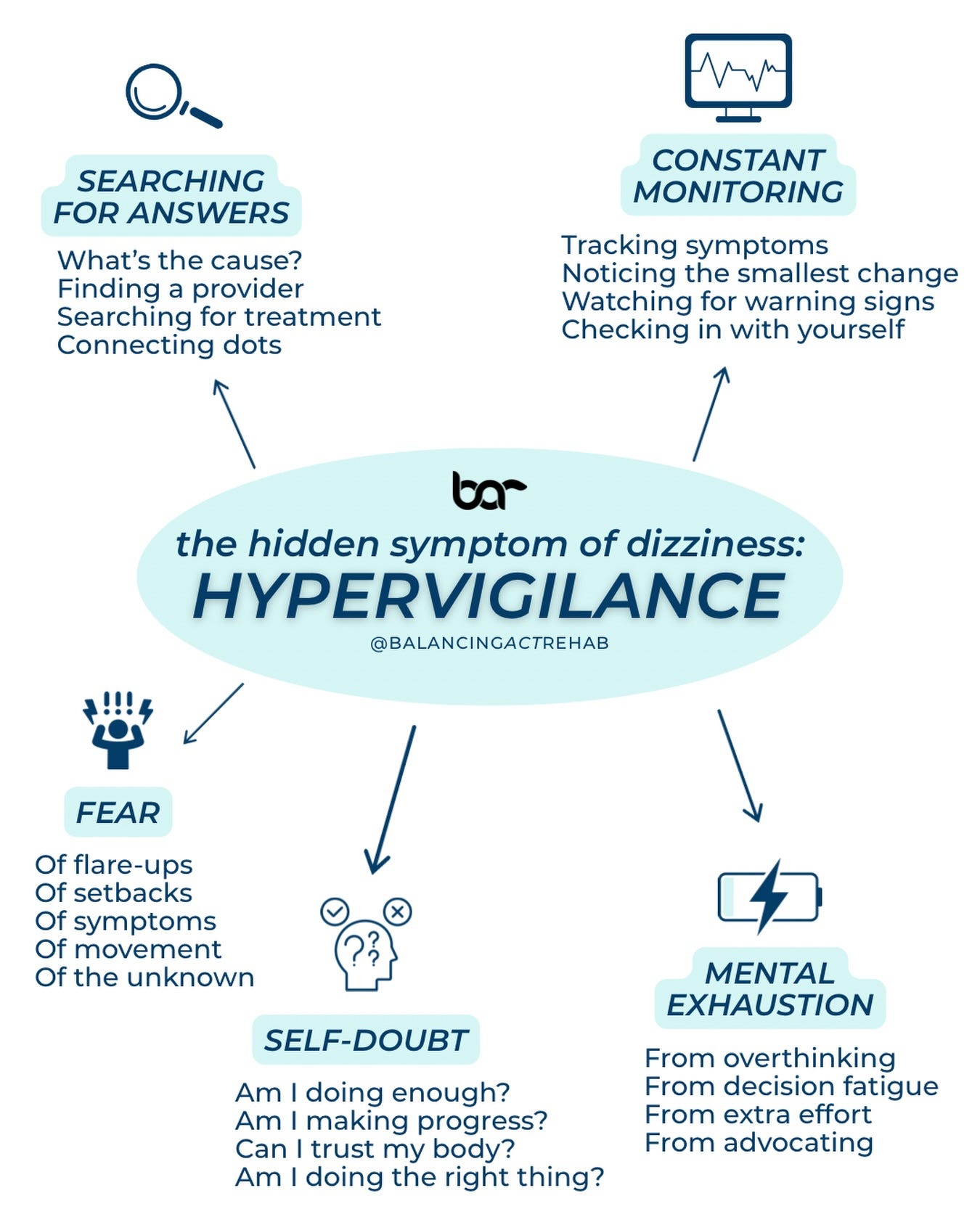
As highlighted by physical therapist Dr. Abby Ross, PT, DPT, NCS, and the specialized neurological team at Balancing Act Rehab (BAR), this response shifts the brain into “Searching for Answers.”

Because the brain no longer trusts its internal compass, it initiates a top-down threat assessment. It begins to treat normal, everyday environments—like a crowded grocery store or a walking path—as immediate physical threats, locking you into a state of hypervigilance.
The Exhausting Cycle of Constant Symptom Monitoring
When you experience chronic dizziness, your brain strips away the autopilot feature of balance. Every step requires conscious thought, planning, and evaluation. This constant monitoring leads directly to profound mental exhaustion through several daily challenges:
Tracking Symptoms: You find yourself noticing the absolute smallest change in your body or orientation, wondering what caused it.
Watching for Warning Signs: You constantly scan your surroundings to predict and prevent a potential flare-up.
Decision Fatigue: Simple choices, like whether to walk down a specific aisle or look up at a high shelf, require immense cognitive effort.
Connecting the Dots: Your mind works overtime, trying to link your symptoms to specific triggers, creating a state of perpetual self-doubt in which you ask, “Can I trust my body?” or “Am I doing the right thing?”
This extra effort means your brain is running a marathon just to keep you standing still, leaving very little energy for the rest of your life.

How Fear Drives Maladaptive Movement Strategies
Hypervigilance does not just tire out your mind; it fundamentally changes how you move your body. When fear of setbacks, flare-ups, or unexpected movement takes over, the brain forces the body into a protective, rigid posture.
Patients often develop a strong visual or surface dependency, relying heavily on staring at the floor or feeling the ground to feel secure. You might find yourself locking your neck, stiffening your shoulders, or shortening your stride to prevent your head from moving.
While this bracing feels like a safe defense mechanism, it is actually a maladaptive sensory strategy. By locking your body down and avoiding natural movement, you prevent your brain from relearning how to use its balance signals correctly. This stiffness reinforces the brain’s false belief that movement is dangerous, perpetuating the cycle of dizziness and fear.

How to De-Escalate Your Balance System
Breaking free from hypervigilance requires retraining the nervous system to realize that movement is safe and that your body can handle changing environments. Healing is not just about treating the inner ear; it is about calming the overactive, over-monitoring brain.
Effective recovery programs focus on:
Gradual Desensitization: Safely exposing the balance system to complex visual patterns and moving surfaces to reduce visual and surface dependencies.
Habituation Exercises: Using gentle, repetitive head and body movements to teach the brain that motion is not a threat.
Cognitive Calming: Learning to recognize that a brief increase in dizziness is simply a temporary sensory mismatch, not a sign of permanent damage or a true setback.
By using targeted sensory retraining techniques, such as the systematic approaches used in the Sensory Integration Method, we can teach the brain to relinquish its constant control. Shifting your balance back to an automated, subconscious level eliminates mental exhaustion, builds physical confidence, and allows your nervous system to return to a peaceful equilibrium.