

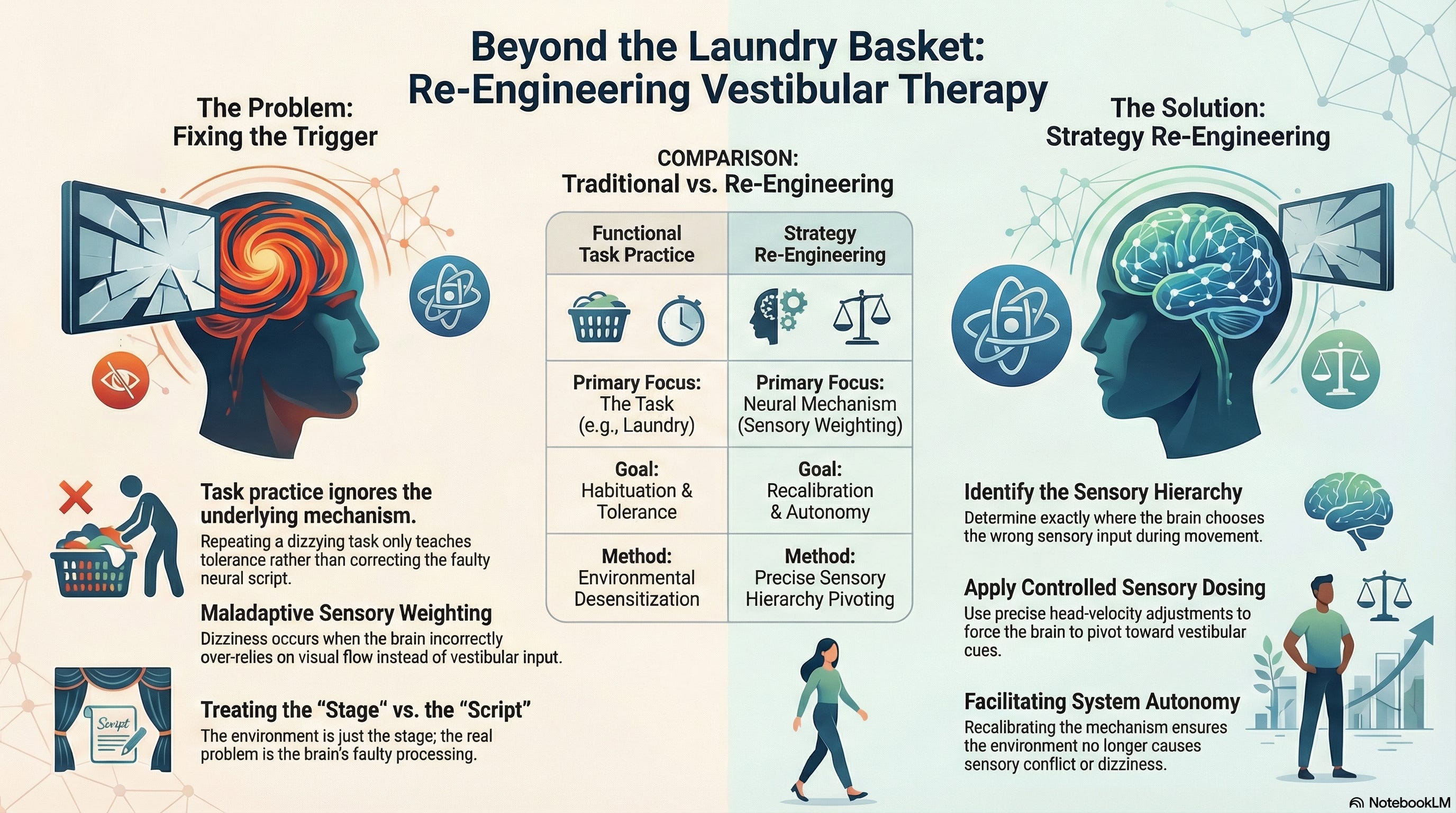
The laundry problem is not a laundry problem.
When patients like ‘Mrs. Smith’ struggle with daily tasks—like reaching into a laundry basket and looking up to a shelf—the dizziness they experience is often treated as something to be ‘habituated’ to. We have been taught to practice the task until the system simply gets tired of complaining. But this approach often falls short because it focuses on the trigger rather than the underlying mechanism.
In this video, we explore the shift from environmental desensitization to strategy re-engineering. We discuss how the brain, obsessed with computational efficiency, often adopts a maladaptive sensory strategy by over-reliance on visual flow or somatosensory input while down-regulating vestibular input.
Key Insights Covered:
The Mechanism of Mismatch: Why ‘Mrs. Smith’ feels dizzy due to inappropriate sensory weighting between her eyes and her internal ears.
The Strategy Pivot: Why we must move away from ‘practicing the task’ and toward deliberate, structured recalibration of the neural script.
Recalibrating the Engine: How advanced clinicians use specific head-velocity dosing and sensory re-weighting to facilitate system autonomy.
Clinical Implementation: A practical, low-risk starting point for therapists to begin identifying and debugging these maladaptive strategies in their current practice.
Stop trying to fix the patient within the task. Instead, re-engineer the maladaptive strategy so the environment no longer causes conflict.


